 |
| Cebu Metropolitan Cathedral |
Cebu is one of the famous tourist attractions to go to in the Philippines. It is known for its pristine white beaches, friendly and hospitable people, and historical attractions. And when one visits this tropical island, he/she should never forget to explore the Cebu Metropolitan Cathedral.
The Cebu Metropolitan Cathedral is a must-see landmark in Cebu. It is one of the oldest Spanish colonial churches in the Philippines. It is the house of the Archdiocese of Cebu which was founded on April 28, 1934. The cathedral showcases history, religion and architecture in one package.
The cathedral had been alive as early as 14th century. It started in 1578 when a Diocese in Manila was established as a suffragan, or a bishop subordinate, of the Archdiocese of Mexico. Thinking that the diocese’s territory is too wide since it is the only diocese in the Philippines that time, Bishop Domingo de Salazar requested that another diocese be made. And in August 14, 1945, Cebu became a one of the diocese subordinates of the Archdiocese of Manila and the Cathedral was established as its church.
As years passed by, the cathedral faced many problems, most especially on its construction. It started out as church made in nipa and wood and its belfry made of wooden posts. When Fray Juan Lopez was appointed as Bishop, he said that it was “in a sorry state”. He then requested the King of Spain to set-up an encomienda to generate incomes that will be used as funds for the church’s construction. His successor, Bishop Diego de Aguilar, initiated the construction in 1689 but it was stopped because of they lack funds. When Bishop Sebastian de Foronda took over, he said that his seat was like a “barn which was overrun by plants and grasses”. Because of this, Juan de Ciscara, a military engineer, made the plans for the church but again, it was stopped because of lack of funds. The same thing happened in 1741-1762. The then Bishop Lino de Espeleta wrote a letter to the King about the situation of the Cathedral. He requested money from him and asked for money in other archdioceses. He was able to buy limestone out of the funds collected but the lack of resources and labor ended the project. It was not until 1834 that the belfry was finished under the administration of Bishop Santos Gomez Marañon. In 1863, Gov. Rafael Echague asked for the services of Don Domingo de Escondrillas of the Public Works in Cebu to do immediate repairs and widening for the cathedral. In 1898, Bishop Martin Garcia Alcocer, who was the last Spanish Bishop of Cebu, decided to build another church but it was stopped because of the revolution. Eventually, Bishop Juan Bautista Gorordo, the first Cebuano Bishop of Cebu, was able to finish it during his term. Then his successor, Archbishop Gabriel Reyes, commissioned Engr. Gevino Unchuan and some architects to renovate the cathedral. But after a few years, the newly-renovated cathedral was destroyed by bombings during the World War II. Archbishop Julio Rosales led the reconstruction of it together with Fr. Tomas Maglasang, a parish priest, who collected and solicited the funds.
Despite the circumstances faced by the church’s construction, it still pushed through because of its religious impact among Cebuanos. According to Fr. Maglasang, there are many reasons as to why the cathedral has a significant part among Catholics. First, it is where the well-known Filipinos like Sergio Osmeña, and the Sotto, Cuenco and Borromeo brothers were baptized. Second, it is where famous Spanish and Filipino priests and bishops were consecrated. Third, it is where our young soldiers prepared to fight the Japanese army. Fourth, it is located near Basilica Minore del Santo Niño, another sacred place among Cebuanos. And lastly, it has become the mother church of the archdiocese for 77 years.
 |
| hanging lamps |
 |
| lampposts |
 |
| mini fountain |
Aside from its historical and religious aspect, the Cathedral is also known for its architecture. As one enters the Cathedral, he/she will be in awe with its outside perimeter. Trees are placed just beside the fence. Those trees are decorated with spherical hanging lamps that add brightness outside. Aside from the hanging lamps, there are also lampposts scattered in the parking lot. It is a column with four other lamps attached to it. A sculpture of a woman can be seen on each side of the column. On the right side of the cathedral, one can see the new courtyard, built in honor of San Vidal, the patron saint of the cathedral. At the center of it is a mini fountain which gives an interesting view to those who sit and relax in the yard. Just beside is the Cebu Cathedral Rectory, which houses the parish priest. Near the rectory is another fountain, decorated with artificial stones and bamboo, which gives style to the parking lot. But the most interesting sight in the outside perimeter is the statue of Blessed Virgin Mary. What makes it interesting is that it is a Filipino version of the Virgin Mary. She is wearing a baro’t saya, the national dress of the Philippines, while carrying her baby, Jesus Christ.
 |
| courtyard |
 |
| Virgin Mary |
Another thing to look forward to in the Cathedral is its exterior. It is in Baroque-Rococo architectural style, which is very complex, and illustrates more colors and emotions. At the topmost part of the structure, one can see the façade adorned with floral motifs. Like all churches, there is a cross at the top with a globe as its base. Below it is a clamshell medallion with an “IHS”, the most holy name of Jesus, inscripted inside. Just below the medallion are three niches: San Pablo and San Pedro in the left and right niche and a stained glass window in the center niche. On both sides, just beside the niches, are two fu dogs. At the left side of the structure, one can see the century-old belfry. At the topmost part of it is a big clock. The bell tower currently follows the Carillon Digital Bell System and has a 21 bell-chime that gives good music during holy services. Just below the bells is a stained glass window with Blessed Pedro Calungsod in it. At the lower part of the structure is the cathedral’s door. It is made in wood. The most appealing thing of the door is its design which will greet whoever enters the cathedral. Each side of the door has a sculpture of a bird flying downward. Below it are two columns. Each column has a sculpture of three angels and a cross. Just beside the door are statues of two fu dogs facing each other and guarding the cathedral.
 |
| belfry |
 |
| facade |
 |
| stained glass window |
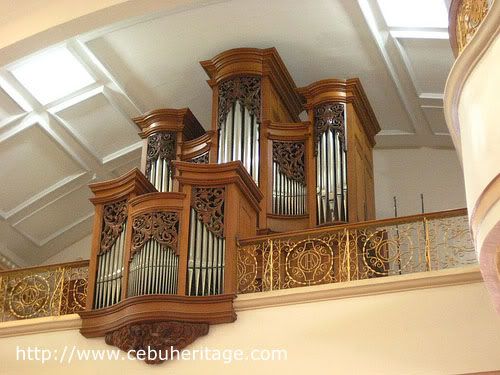
Aside from the exterior, the cathedral’s interior will give delight to churchgoers with its designs and embellishments. On the front part is the main retabla, or a decorative partition in which religious statues are placed. Next to it is the altar table adorned with gold and flowers. On the left side of it is the seat of the Archbishop of Cebu. The seat is painted in gold which gives it a sense of power and authority. On both sides of the cathedral are two fully air-conditioned confessional boxes. Just beside these are staircases leading up to the 2nd floor. In the 2nd floor, there are nine balconies: four balconies on both sides facing each other and another balcony facing the altar. The lone balcony holds the pipe organ. A set of chandeliers are hanged in the ceiling which add brightness inside the cathedral.
 |
| pipe organ |
But the most attractive thing inside the cathedral is the three retablas. The first retabla is situated in the altar. At the top of it are the initials “JHS”. Below it are three niches. The central niche holds the crucifix. The left niche holds the statue of San Lorenzo Ruiz while the right niche holds the statue of Blessed Pedro Calungsod. The tabernacle, the box in which the Eucharist is placed, is situated under the niches. The second retabla features the popular patron saints of the Cathedral. The first niche holds the statue of San Jose. Below it are three other niches. The central niche holds the statue of Immaculada Concepcion. The left niche holds the statue of San Antonio de Padua while the right niche holds the statue of San Vicente Ferrer. The third and last niche features the martyr saints. The first niche holds the statue of Sta. Valeria, the wife of San Vidal. The central niche features a bas-relief, a sculpture but with less depth, which shows the martyrdom of San Vidal. The left and right niches hold the statues of San Vidal’s sons, namely San Protacio and San Gervacio. These wooden partitions are made in Philippine mahogany. Like the façade, they are adorned with floral motifs and a crucifix is placed just under the central niches. Corn-like lamps surround the retablas. The retablas are painted in gold, exuding elegance and class.
The cathedral has made its way not just in the hearts of Cebuanos but also on the tourists who had experienced and explored its quality and excellence in history, religion, and architecture. It is indeed a must-see landmark.
Reference:
Balaanong Bahandi: Sacred Treasures of the Archdiocese of Cebu, Cathedral Museum of Cebu and University of San Carlos Press, 2009
Pictures:
Cebu Metropolitan Cathedral, http://www.travel2vacations.com/places/cebu-paradise-history-rich-enough/
